
Sources for Freehold Township Previous Residents
A backward address search changes with the era. Start with a current parcel record to obtain a block, lot, and legal description, then use the land index for recorded transactions. Historical directories, censuses, obituary indexes, and early tax ratables answer different questions. The table separates the sources so a landowner is not automatically treated as an occupant and a directory listing is not treated as proof of title.
| Source | Years It Covers | Where Held | What It Shows |
|---|---|---|---|
| OPRS deed index | Deeds 1970-present | Monmouth County Clerk online and in person | Recorded parties, document identifiers, and parcel clues |
| Freehold directories | 1922-1982 selected volumes | State Library inventory; library and historical collections | Address and household leads where the volume applies |
| Monmouth directory microfilm | 1875; selected 1885-1921 runs | New Jersey Historical Society guide | Earlier county-level address or name leads |
| Federal census | Released schedules through 1950 | National Archives and local research collections | Household chronology, subject to schedule and district checks |
| State Archives tax ratables | 1776-1796 selected volumes | New Jersey State Archives | Taxpayer and property-obligation clues |
For a post-1970 transaction, begin with the deed index. For a mid-century household question, test available Polk volumes before jumping to a census. For an early property question, the historical jurisdiction and tax-ratable books may be the better starting point. Note: A source date controls what it can establish about a past address.
Start With a Freehold Township Parcel
The Monmouth OPRS property search is the practical first stop for a known address. Its address route requires Township Name and Address and accepts a street name or partial street name. Block and Lot mode accepts Township Name, Block, Lot, and an optional Qualifier. Map mode uses zoom, right-click, and radius controls. Owner mode accepts a partial current owner name. Preserve the returned property location, block, lot, qualifier, tax-list year, and source date before moving to a different database.
The tax-list module is separate from the property search. Its street route uses Street Name, Township, and Year, while owner and block-and-lot routes add their own fields. The year selector is the way to discover what tax-list years the system makes available; the landing page does not state the earliest Freehold Township year. The assessor can help resolve an ambiguous street name or prior parcel identifier. The township page identifies Matthew R. Barbieri as assessor at 732-294-2040 and Brittanni Kay as tax clerk at 732-294-2041.
Trace a Monmouth County Deed Chain
Land records follow recorded parties and legal descriptions. They do not list every person who lived at the address. In the Monmouth County Clerk OPRS land index, name searching uses Last Name or Company Name with an optional First Name, a document-type selector, optional dates, and a percent sign wildcard. Block-and-lot searching and document-type searching provide other routes. Results lead to instrument or book/page references and an image view.
- Record the current parcel's block, lot, qualifier, and legal description from the property result.
- Find the current owner's acquisition as a grantee, using the parcel clues and a date range.
- Capture the instrument number or book/page, recording date, seller or grantor, and document type.
- Search that seller as an earlier grantee at the same legal description, then repeat backward.
- When the online trail reaches its cutoff, ask the County Clerk for the earlier deed book, image, or in-person examination route.
- Grantor
- The party transferring or selling an interest in a recorded deed.
- Grantee
- The party receiving or buying the interest shown by the recorded instrument.
- Chain of title
- The sequence of recorded transfers used to follow a parcel through time.
- Legal description
- The block, lot, qualifier, subdivision, metes-and-bounds, or other parcel description that remains useful when an address changes.
The Clerk describes online information as informational, not a title search. Use a certified copy or an in-person title examination when legal reliance is needed. A mortgage, lien, or foreclosure filing is a record of a filing, not evidence that a named party lived at the property.
Freehold Township Previous Residents and Record Cutoffs
OPRS coverage depends on document type. Deeds are indexed from 1970 forward, mortgages from 1976, IRS liens, withdrawals, and releases from 2010, and other published records from 1996. The general land page describes records from October 1, 1996 onward and limits broad date searching to 90 days. Keep those statements together because a document-type-specific result can be older than the general online date description.
Once a search reaches the deed cutoff, shift from the online index to the County Clerk at 33 Mechanic Street in Freehold, or make a precise request for the instrument, book, page, party, and recording date. County archives, MCHA, the State Archives, and library microfilm form the next historical route. The change in access point is not a dead end; it is a reason to tighten the parcel identifiers first.
Pair Freehold Township Directories and Census Years
Directory and census work reconstructs past residents, rather than merely past owners. Use the reverse street section of an available directory to find an address, copy the printed occupant and neighboring entries, and then confirm the name in the alphabetical section. The official research did not locate a digitized Freehold reverse page or an individual entry image, so a reverse result remains a lead until the actual volume is inspected. The collections themselves are detailed in the Freehold Township city directory record path.
- Place the address, street spelling, and directory year in a household worksheet.
- Check the matching alphabetical listing and retain every printed abbreviation without expanding it by guesswork.
- Compare the next available directory volume, marking the years with no verified volume.
- Pair a directory year with the closest released federal census, while keeping different publication and enumeration dates in mind.
- Use an obituary, cemetery transcription, deed, tax record, or probate file to test why a name appears or disappears.
Federal census records follow the general 72-year release rule, with released schedules through 1950. A census can place people in a household, while a directory may provide a more frequent address clue. Neither source by itself proves that someone owned the parcel.
Freehold Township Past Residents: Owner Versus Occupant
The distinction is essential. OPRS MOD IV and tax data can show owner name, mailing address, property location, assessment, and detailed parcel fields. The situs or property location is the physical parcel. The tax mailing address is where the notice is sent. An owner can receive mail elsewhere, and an owner field does not identify every person who lived on site. A directory or census listing, in turn, can identify a dated household without proving ownership.
Keep one column for role and another for source date: owner, recorded party, occupant, taxpayer, or mail recipient. This prevents a deed chain from being turned into a resident list. If a property has a trust, estate, business, or out-of-town mailing address, follow the documented parcel and transaction record instead of inferring personal residence. Note: The absence of a name from an owner field does not establish that the person was absent from the address.
Freehold Township Tax Maps and Lower Freehold
Tax maps bridge an old legal description to a modern parcel. The township map resources include tax, street, zoning, wetlands, trails, polling, and other maps. The older tax-map material lists cover and index sheets plus parcel sheets 1-73, including fractional blocks. A cited 2008 tax-map PDF can show block numbers, roads, easements, conservation easements, exempt parcels, and legal-description context. Pair a dated map with the OPRS parcel card and the Clerk index because the map is not a current ownership record.
The historical name Lower Freehold is another bridge. The State Archives tax-ratable guide lists volume 1123a for 1776 and a sequence through volume 1137 for June-August 1796, including volume 1138 for July 1787 under Lower Freehold. The State Archives catalog allows collection-level searching by text, year, county, and series number.
The State Archives catalog shows the filters that can narrow an early Freehold or Lower Freehold search before an appointment or records request.
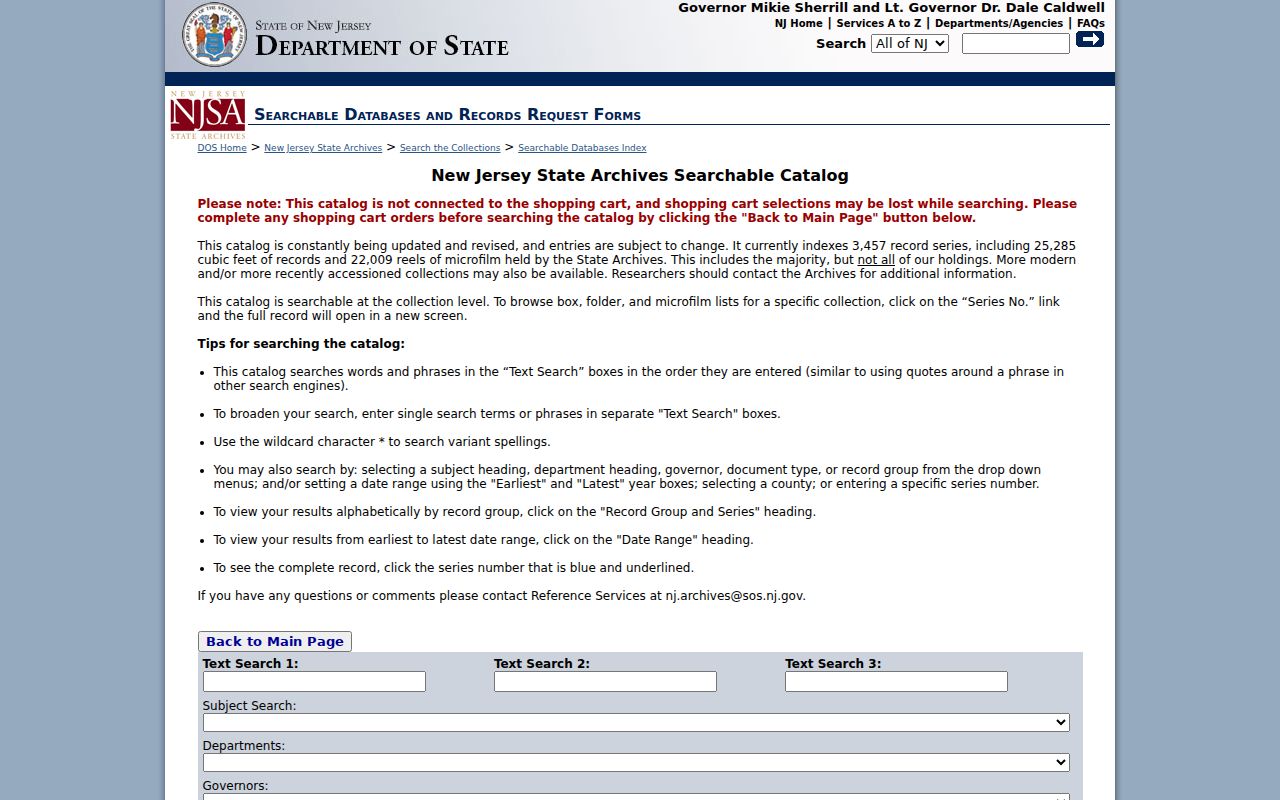
The catalog result identifies a collection-level path, so preserve the series and year details before asking the Archives to locate a particular volume.
Freehold Township Previous Residents After Fires
Monmouth County's custody history helps explain why an old house trail can move between institutions. The county history records major damage from a jail fire in 1855, a courthouse fire in 1873, and a 1930 fire that damaged the stairway and belfry. Most vital records were reportedly saved after the 1873 fire. Instead of assuming a missing family record was destroyed, check whether the County Clerk, Archives, MCHA, State Archives, church records, or library shelves hold the relevant surviving series.
The MCHA Research Library is an appointment-only local route at 70 Court Street in Freehold. It reports more than 1,000 manuscript collections and lists a focused search at $10 or broader genealogy work at $35 per hour with a quote first. A request should state the address or name, place, approximate years, and record type. This route is especially useful for an obituary, church item, Bible entry, or other specific historical question.
Freehold Township Previous Residents for House History
House-history research works best when it stays tied to the property and dated historical sources. Construction records can add a separate trail: Freehold Township's Construction Department handles permits, inspections, and certificates of occupancy, while the municipal code describes permit and complaint books as subject to inspection. No public parcel-by-parcel permit index was located. Ask for a specific address, block/lot, record type, and date range through the department or the township OPRA route.
The MCHA Research Library access page describes the appointment setting, collection access, and research-service options that complement a parcel search.
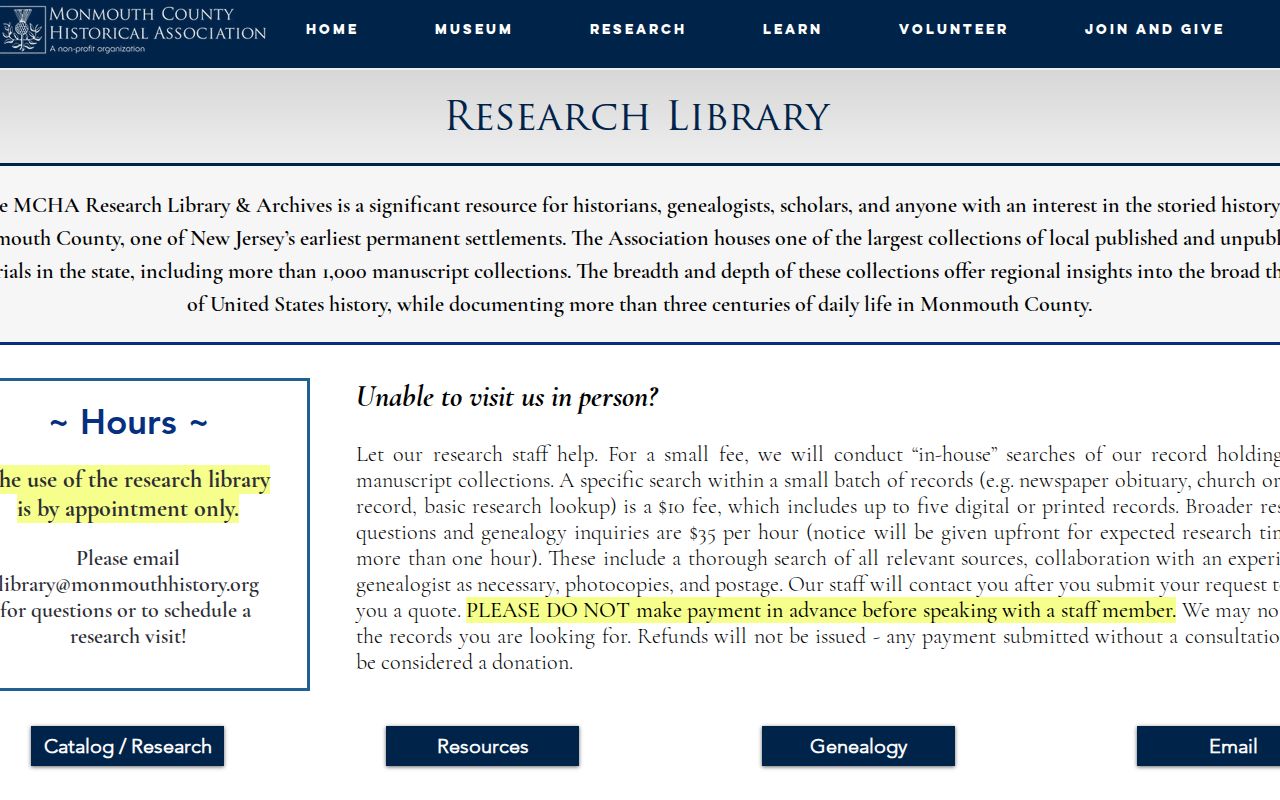
The library route is a practical follow-up when a dated address needs newspaper, church, obituary, cemetery, manuscript, or estate context.
Lawful use. Use Freehold Township previous-resident research for family history, estate questions, property history, and personal curiosity. Do not use a historical address trail to stalk, harass, or harm any living person.