
Freehold Township City Directory Holdings
The published Freehold shelf is not one uninterrupted annual run. The official New Jersey State Library holdings inventory identifies the most precise sequence, while Monmouth County collections provide related county directories and local-history material. Start with the date closest to the question, but write down the publisher and geographic wording on the title page. A book called Freehold may refer to a different municipal scope than a record explicitly naming Freehold Township.
| Collection | Years | Where Held | Access |
|---|---|---|---|
| Richmond's Freehold City Directory | 1922-23 | State Library inventory; Asbury Park Public Library reel | Confirm the reel location before travel |
| Polk's Freehold Directory | 1937-38 | State Library inventory; Asbury Park Public Library reel | In-person holdings check |
| Selected Polk Freehold volumes | 1947-1982 selected volumes | State Library inventory; Asbury Park Public Library books and reels | Inspect the specific available year |
| Monmouth county directory microfilm | 1875; selected 1885-1921 runs | New Jersey Historical Society guide | Check each volume's geographic scope |
Freehold Township is expressly included in the Polk run from 1971 onward, including the 1982 title that names both Freehold Borough and Freehold Township. Earlier volumes can still be valuable, but their title and contents must be checked before treating a listing as township evidence. Note: The verified holdings contain gaps, so an absent year is not proof that a household was absent.
Freehold Township Printed Directory Spine
The known published spine begins with Richmond's 1922-23 directory, resumes with Polk in 1937-38, and then has selected Polk volumes from 1947 through 1982. The sequence includes 1947, 1949-50, 1952, 1954, 1955, 1956, 1957-58, 1959-60, 1961, 1962, 1964, 1965, 1967, 1968, 1969, and 1970 before the volumes that explicitly include Freehold Township. That pattern is a useful numbers-based guide to what can be compared, not a claim of annual publication.
| 1922-23 | Richmond's verified Freehold directory |
|---|---|
| 1937-38 | Polk's verified Freehold Directory |
| 1947-1970 | Selected Polk Freehold City Directory volumes |
| 1971-1982 | Selected Polk volumes that explicitly include Freehold Township |
A definitive final printed Freehold year was not located in the official sources. Treat 1982 as the last verified inventory item, rather than saying that printing ended then. A later address question may need a property, deed, or tax record instead of a historical volume.
Freehold Township Directory Microfilm Before 1922
The New Jersey Historical Society guide extends the historical search beyond the verified Freehold spine. It lists Monmouth County city-directory material for 1875, 1898-99, and 1904-05, along with a ten-reel run covering 1885-86, 1891, 1897-1901, 1905-17, and 1920-21. It also lists a 1914 Farm Directory. These are countywide or Monmouth holdings, so they serve as a bridge to investigate, not a guarantee of a Freehold Township reverse street section.
For an old address, retain every form of place name found in the record. Freehold Township, Freehold, Freehold Borough, and Lower Freehold can describe different historical or modern contexts. The correct test is the volume itself: read the geographic coverage, locate the address or name, and then compare it to the township, postal, and legal description used by the supporting record.
Read a Freehold Township Directory Carefully
A directory is a dated listing, not a complete biography. Begin in the reverse or street section when the question starts with an address, copy the street spelling and number exactly, and then locate the same person in the alphabetical section. The research did not locate a validated image of an individual Freehold entry, its exact typography, or a publisher-specific abbreviation key. That gap matters: do not assign a spouse, business role, or owner/renter mark until the page image has been inspected.
| Target field | Record the surname and given name or initials exactly as printed. |
|---|---|
| Household detail | Capture spouse or widow notation only if the volume displays it. |
| Work or business detail | Transcribe any occupation, firm, or business role without expanding abbreviations by guesswork. |
| Address clue | Keep the house number, street spelling, and year together. |
| Reverse check | Use the street entry for occupant and neighboring-entry clues, then confirm alphabetically. |
- Criss-cross directory
- A directory section arranged by street or address so an address can lead to a printed occupant.
- Householder index
- An alphabetical listing that may place the main listed person before an address and related notation.
- Abbreviation key
- The volume's own explanation of shortened terms; photograph or transcribe it before interpreting a listing.
Freehold Township Directory Research Desks
Local shelves and staff supply the access channels that a web search cannot. The Monmouth County Library Historical Room at Headquarters Library keeps its local-history material in the NJ-Room, where books, magazines, directories, and scrapbooks are largely non-circulating and reference librarians assist. Headquarters is at 125 Symmes Drive in Manalapan. The library reports Monday through Thursday hours of 9-9, Friday and Saturday 9-5, and Sunday 1-5, with summer Sunday status to be checked.
The MCHA genealogy holdings add church records, obituaries, cemetery transcriptions, wills, local vital material, and directory references. MCHA is appointment-only. A focused request is listed at $10 for up to five digital or printed records, while broader genealogy work is listed at $35 per hour with a quote before payment. Give staff the name, place, approximate years, record type, and likely newspaper or denomination.
These two research desks answer different access needs. The NJ-Room is the practical place to browse non-circulating local material with librarian help. MCHA is suited to a narrow historical request when the relevant church, cemetery, newspaper, manuscript, or family record has already been identified. Neither collection should be described as a complete online name index.
The MCHA genealogy page identifies the local collections that can turn a printed name into a family-history lead.
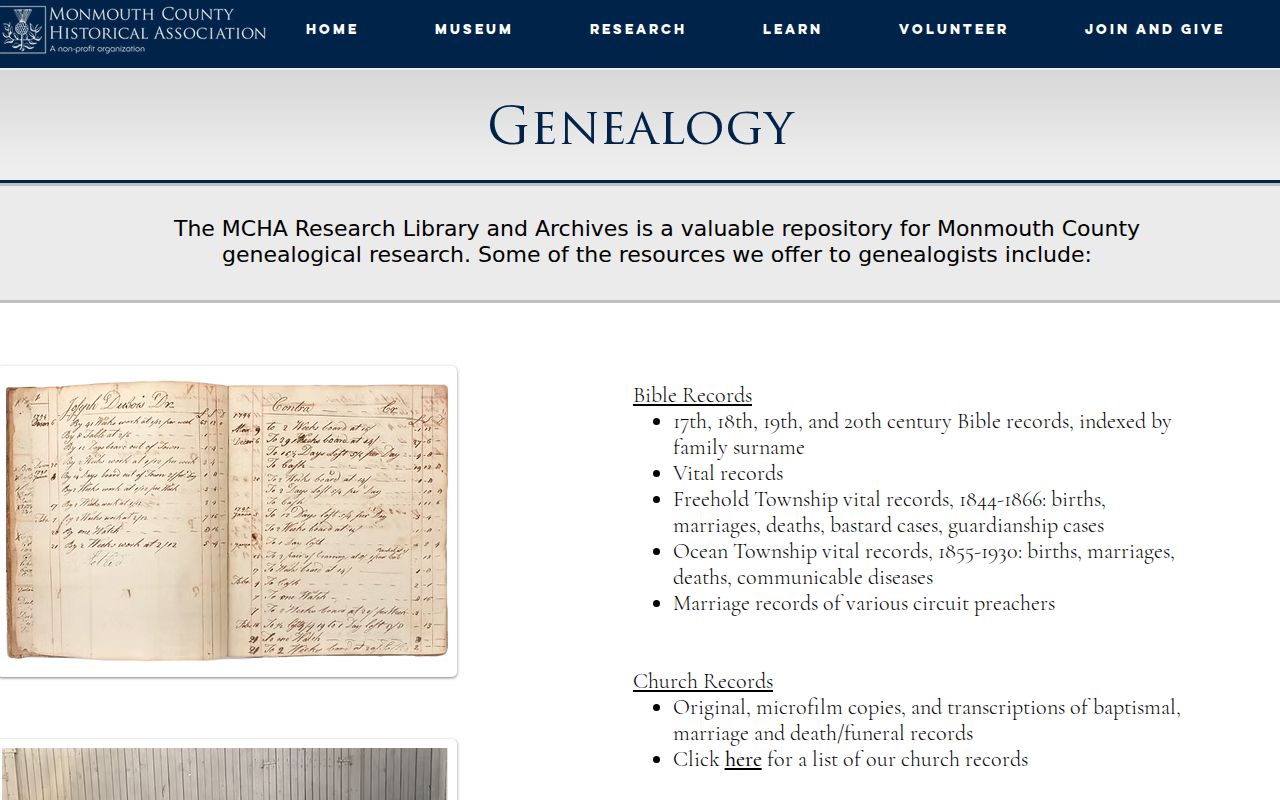
That collection context is useful when a printed entry needs a church, obituary, cemetery, will, or manuscript follow-up rather than an unsupported conclusion.
Freehold Township Records After Courthouse Fires
The county's record history explains why city-directory research is spread across several shelves. A jail fire caused major damage in 1855, a courthouse fire required rebuilding in 1873, and another fire damaged the stairway and belfry in 1930. The county history says most vital records were saved after the 1873 fire. A family story that labels an early record “lost” should therefore be tested against the County Clerk, Archives, State Archives, MCHA, and library holdings before it is accepted.
Older material is not all online or in one room. County Clerk and OPRS systems hold newer index and image material, while archive, library, and historical-association collections preserve books, microfilm, transcriptions, and context. This local records story is a reason to carefully record the repository and series name beside every historical finding.
The courthouse moved to a new building in 1954, and the prior structure became the Hall of Records. That sequence helps explain why a Freehold Township city-directory search may move among county offices, a library shelf, the State Archives catalog, and MCHA rather than stopping at one online name result.
Trace a Freehold Township Household
Use a household worksheet rather than relying on one historical-directory finding. Each column should preserve the directory year, address as printed, surname spelling, alphabetical confirmation, and the next record to check. Pairing directory years with federal census years helps establish a chronology, but the publication date and census enumeration date are not the same. The 1922-23 or 1937-38 volume can be compared with the 1920 or 1940 census as a date check, while the postwar Polk volumes can show later continuity.
- Find the earliest available address or alphabetical entry closest to the question.
- Copy the printed spelling, street number, street name, directory year, and any notation that appears.
- Check the matching alphabetical or reverse section, depending on the entry point.
- Move backward and forward through the next available volumes, marking missing years as gaps.
- Compare the resulting chronology with the appropriate federal census, deed, tax, obituary, or probate record.
A disappearance can mean a move, death, non-listing, or a directory gap. MCHA obituary indexes and estate material can help test the first two possibilities, but a widow notation or a similar surname alone does not prove a legal relationship. Note: Federal census records are released under a general 72-year rule, and local schedule details still need repository confirmation.
Freehold Township Directory Leads Beyond Entries
When the printed-directory shelf ends, early taxpayer records provide a different kind of place-and-name trail. The State Archives guide identifies Freehold Township tax-ratable volumes from 1776 through 1796, including volume 1123a for 1776 and volume 1138 for July 1787 under the name Lower Freehold. These are taxpayer and property-obligation records, not household directories, but their book numbers make a precise archive request possible.
Search terms should include the historical jurisdiction label as well as the modern township name. The New Jersey State Archives catalog supports collection-level searching by text, year, county, and series number. Its result identifies a collection, not necessarily a digitized page, so follow the catalog result with an Archives request, appointment, or repository consultation.
Freehold Township Directory Follow-Up Leads
A directory name gains context from the local collections around it. MCHA holds Freehold Township vital material for 1844-1866, church records in original, microfilm, and transcription forms, and Monmouth wills and estates from 1693-1800 on microfilm. Its obituary indexes cover the Monmouth Inquirer from July 1830-1888, the Monmouth Democrat from July 1830 through December 1884, the Freehold Transcript from September 1888-1919, and the Red Bank Register from June 1878 through December 1988.
An obituary index is a lead, not the complete newspaper item. Requesting the clipping or original page can supply details that an index does not show. For modern address-keyed property evidence, use the separate Freehold Township street directory record path rather than trying to make a historical volume answer a current question.